TonicNest may earn a commission if you buy through links on this page, at no extra cost to you. That does not change what we report.
Part of our Kerassentials overview. Last checked October 19, 2026.
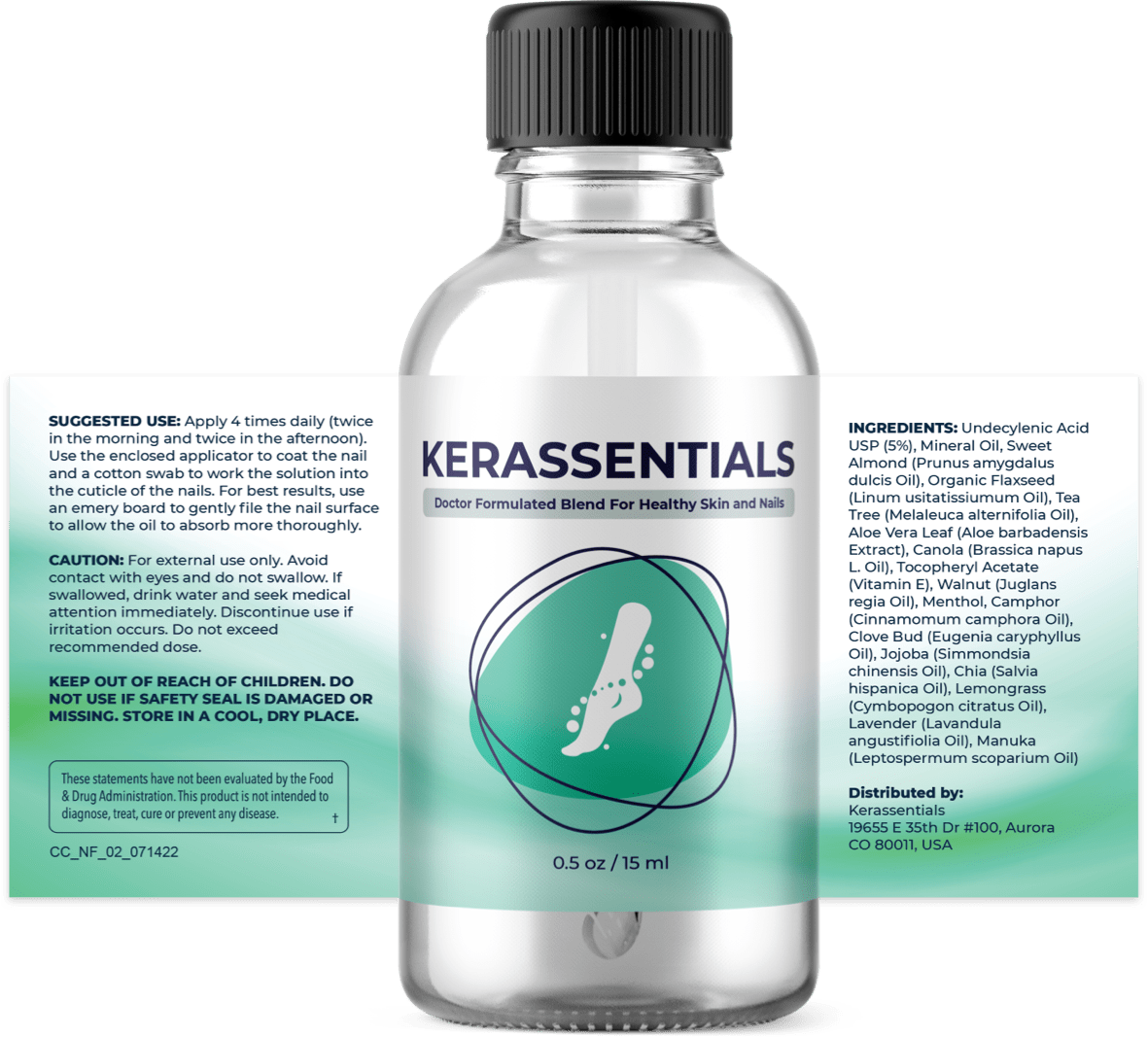
Kerassentials ingredients are a 5% dose of undecylenic acid mixed with essential oils and plant carrier oils, in a 0.5 oz (15 ml) brush-on bottle for external use only. The vendor's site shows two label versions, one with 9 ingredients and one with 17.[1][2] Only one of those items has a printed amount: undecylenic acid USP 5%.
Kerassentials ingredients at a glance
Undecylenic acid is the only ingredient with a stated amount, and it is the only one covered by FDA rules for skin antifungals. Everything else is undisclosed. Label A is the clear-glass bottle, label B the amber bottle. The "role" column is our reading of why each item is there.
| Ingredient | Label | Role (our reading) | Amount disclosed? | Evidence grade |
|---|---|---|---|---|
| Undecylenic acid USP | A, B | Antifungal active | Yes, 5% | Moderate on skin; weak on nails |
| Tea tree oil | A, B | Essential oil | No | Limited |
| Lavender oil | A, B | Essential oil, scent | No | Weak |
| Lemongrass oil | A, B | Essential oil, scent | No | Weak |
| Clove bud oil | B | Essential oil | No | Weak |
| Manuka oil | B | Essential oil | No | Weak |
| Camphor, menthol | B | Cooling agents | No | Weak |
| Almond, walnut, flaxseed, chia, canola, jojoba oils | A, B (walnut, chia, canola, jojoba on B only) | Carrier oils | No | Not studied |
| Aloe vera leaf extract | A, B | Skin conditioner | No | Not studied |
| Mineral oil, isopropyl palmitate | B, A | Base and spreading agents | No | Not studied |
| Vitamin E (tocopheryl acetate) | A, B | Antioxidant for the oil | No | Not studied for nails |
What is in each ingredient, and what does research say?
Most of the human research on these ingredients is about athlete's foot skin, at strengths far above or different from what this oil discloses. Here is each one in turn.
Undecylenic acid (5%)
A fatty acid sold in nonprescription antifungal creams and powders. In athlete's foot, a powder with 2% acid plus 20% zinc undecylenate gave 88% negative cultures against 17% for placebo after four weeks.[3] An ointment matched 1% tolnaftate.[4]
FDA's skin monograph covers 10% to 25% total undecylenate, so 5% falls below it.[5] On human nail pieces in a lab, 25% solutions reached nail fungus far less well than prescription efinaconazole.[6] Grade: moderate on skin, weak for nails.
Tea tree oil
Oil from the Australian Melaleuca alternifolia tree. The one nail trial used 100% oil twice daily for six months on 117 people: 18% had negative cultures against 11% on 1% clotrimazole, with no placebo group.[7] On athlete's foot, 25% and 50% solutions beat placebo, but 3.8% of users got moderate to severe dermatitis.[8] NCCIH calls the nail research too thin for conclusions.[9] Grade: limited.
Lavender oil
No human trial on nail or skin fungus was found, only lab tests.[10] Lavender is a known cause of allergic skin rashes.[11] Grade: weak.
Lemongrass oil
Lab studies show activity against fungi in a dish, with no human nail or skin data.[12] Grade: weak.
Clove bud oil (label B)
Clove oil slowed dermatophytes and Candida in lab tests.[13] No human nail study exists. Grade: weak.
Manuka oil (label B)
The vendor says manuka "is more powerful than tea tree oil" and gives no source. The only human trial found was for eczema, where a 2% cream did no better than the plain base.[14] Grade: weak.
Camphor and menthol (label B)
Neither has a nail trial on its own. A rub containing both was tried on 18 people with no control group, and 27.8% cleared at 48 weeks.[15] FDA lists both among topical antifungal ingredients without enough data for general recognition.[16] Grade: weak.
Carrier oils, aloe, mineral oil and vitamin E
Almond, walnut, flaxseed, chia, canola and jojoba oils, plus mineral oil and isopropyl palmitate, make up the base that carries the actives across the nail. Aloe and vitamin E condition the skin and protect the oil. None has been studied for nail fungus. Almond and walnut come from tree nuts, which matters for allergies.
How transparent is the Kerassentials formula?
Partly transparent. Every ingredient is named, which beats a hidden blend, but only one amount is printed, so you cannot compare the other 8 or 16 items with study doses.
The arithmetic is simple. A 15 ml bottle at 5% holds about 0.75 ml of undecylenic acid. The other 95%, about 14.25 ml, is split among the remaining items in unknown shares. Tea tree oil could be a few drops or a large share, and the label does not say.
The two labels make it harder. Label A lists 9 items, label B lists 17 and adds mineral oil and walnut oil.[1][2] The sales page also says "No Chemicals", while the label lists mineral oil, isopropyl palmitate, menthol and camphor. Third-party sites copy one list or the other, so trust the label on the bottle you receive. Our lists were checked October 19, 2026.
Ingredient safety and interactions
The main risks are skin reactions, tree-nut allergy and accidental swallowing. The label says external use only, keep it away from eyes and children, and stop if irritation occurs.[1]
- Tea tree and lavender oils are common causes of allergic contact rashes.[11]
- Almond oil (both labels) and walnut oil (label B) come from tree nuts.
- Camphor is dangerous if swallowed; 500 mg has been cited as fatal in children.[17]
No interaction studies of Kerassentials exist. The full list of cautions is on our Kerassentials side effects page.
Do these ingredients prove Kerassentials works?
No. Ingredient studies show what a single substance did at a known strength, usually on skin. They do not show what this blend does on a toenail.
The one disclosed amount sits below FDA's skin range, the best nail data used undiluted tea tree oil, and no study of the finished oil has been published. Our does Kerassentials work page sets out each level of evidence, and the how to use Kerassentials guide covers the daily routine if you decide to try it.
Back to the Kerassentials overview.
Frequently asked questions
What is the active ingredient in Kerassentials?
Undecylenic acid USP at 5% is the only active with a stated amount. It is a fatty acid used in nonprescription athlete's foot products, where FDA sets a 10% to 25% range for skin.
What are the main ingredients in Kerassentials?
Both labels list undecylenic acid 5%, tea tree, lavender, lemongrass, flaxseed and almond oils, aloe and vitamin E. Label B adds clove, manuka, camphor, menthol, walnut, jojoba, chia, canola and mineral oil.
Is Kerassentials all natural?
Not fully. The sales page says No Chemicals, but the label lists mineral oil, isopropyl palmitate, menthol and camphor alongside plant oils. Check the label on the bottle you receive, since two versions exist.
Does Kerassentials contain nuts?
Yes. Both labels list sweet almond oil, and label B also lists walnut oil. People with a tree-nut allergy should ask a doctor before using it, even on the skin.
Is Kerassentials a capsule or an oil?
It is a topical oil in a 0.5 oz (15 ml) bottle with a brush applicator. The label says external use only, do not swallow it, and seek medical help if it is swallowed.
Sources
- Kerassentials product label (image A, 9 ingredients). Kerassentials vendor site, read October 19, 2026.
- Kerassentials product label (image B, 17 ingredients). Kerassentials vendor site, read October 19, 2026.
- Undecylenic acid and zinc undecylenate powder in tinea pedis, placebo-controlled trial (1980). PubMed, read October 19, 2026.
- Undecylenic acid ointment vs tolnaftate and placebo in tinea pedis. PubMed, read October 19, 2026.
- 21 CFR 333.210, antifungal active ingredients. eCFR, read October 19, 2026.
- Ex vivo nail penetration of OTC antifungal solutions vs efinaconazole. PubMed, read October 19, 2026.
- Tea tree oil vs clotrimazole for toenail onychomycosis, randomized trial (1994). PubMed, read October 19, 2026.
- Tea tree oil 25% and 50% solutions in interdigital tinea pedis, placebo-controlled trial. PubMed, read October 19, 2026.
- Tea tree oil. NCCIH, read October 19, 2026.
- Lavender oil antifungal activity, laboratory study. PubMed, read October 19, 2026.
- Essential oils and allergic contact dermatitis, French patch-test series. PubMed, read October 19, 2026.
- Lemongrass essential oil antifungal activity, laboratory study. PubMed, read October 19, 2026.
- Clove oil activity against Candida and dermatophytes, laboratory study. PubMed, read October 19, 2026.
- Manuka oil 2% cream in eczema, randomized trial. PubMed, read October 19, 2026.
- Mentholated ointment for onychomycosis, case series. PubMed, read October 19, 2026.
- 21 CFR 310.545, drug products containing certain active ingredients. eCFR, read October 19, 2026.
- Camphor exposure and toxicity in children. PubMed, read October 19, 2026.
This page is general information, not medical advice. Dietary supplements are not reviewed by the FDA for safety or effectiveness before they are sold and are not intended to diagnose, treat, cure or prevent any disease. Talk to your doctor before taking any supplement, especially if you are pregnant, nursing, take medication or have a health condition.